
Unlocking Growth: The Entrepreneurial Mindset as a Catalyst for Transformation
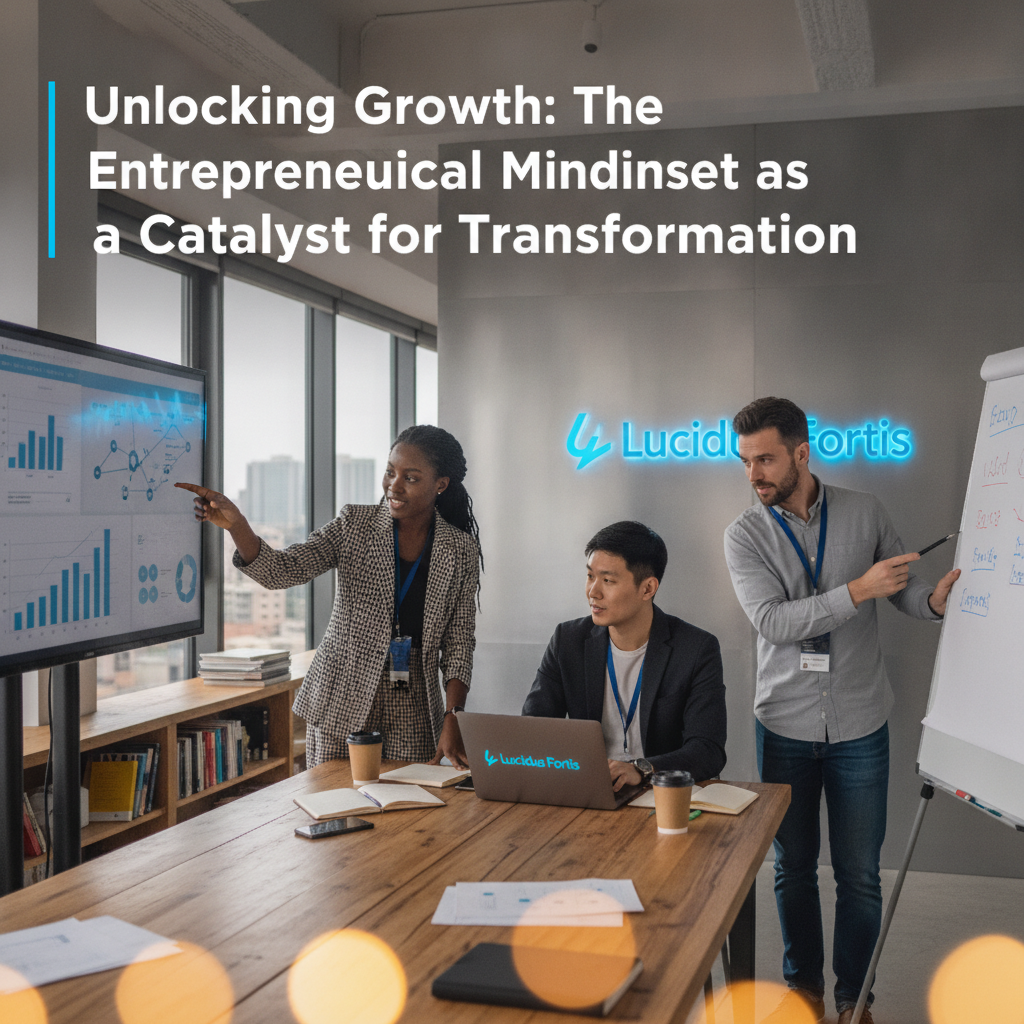
At Lucidus Fortis, we have seen firsthand that the entrepreneurial mindset is the single most powerful driver of organizational agility and growth. This article explores how we embed this mindset into our strategy to unlock innovation, elevate performance, and boost both revenue and employee satisfaction.
The Entrepreneurial Mindset: A Blueprint for Thriving in Disruption
For the enterprise leader standing at the intersection of operational pressure and technological possibility, the question is no longer if artificial intelligence will reshape their industry, but how they will harness it to survive. At Lucidus Fortis, we see too many organizations approach AI not as a strategic lever, but as a technology procurement checklist. They purchase software, hire a few data scientists, and hope for magic. This is a failure of mindset, not technology. An entrepreneurial mindset demands that AI strategy for enterprises be treated as a dynamic, iterative engine for value creation, not a static IT project.
The distinction is critical. Traditional managerial thinking views AI through the lens of cost reduction and incremental efficiency. It asks: How can I replace a task? The entrepreneurial mindset, which we cultivate at LF, asks a far more potent question: How can I reimagine a business model? This shift transforms AI from an operational expense into a growth catalyst. We advise our clients in fintech, healthcare, and manufacturing to build what we call “opportunity-centric AI roadmaps.” Instead of asking which algorithm to deploy, we guide them to first identify the unarticulated customer need or the hidden bottleneck in their value chain. For a sustainable energy client, this meant deploying predictive AI not to lower maintenance costs (a managerial goal), but to create a new revenue stream by selling energy forecasting services to utility grids. That is an entrepreneurial bet.
Our methodology at Lucidus Fortis leverages three specific strategies. First, we establish Innovation Labs that operate outside the core business hierarchy, tasked specifically with rapid AI prototyping. These labs are protected from the “quarterly performance” death grip that kills radical ideas. Here, failure is data, and speed is currency. Second, we run Intrapreneurship Programs where high-potential employees receive “AI equity” and autonomy to solve specific customer problems, with a clear pathway to scaling solutions that prove viable. Third, we redesign leadership development to focus on algorithmic curiosity. Our executives learn to challenge the “black box” of AI, asking not just for the output, but for the bias, the data lineage, and the business logic. This creates a culture where AI strategy is democratized, not dictated.
The results of this entrepreneurial approach to AI are tangible, not theoretical. Through our technology-driven consulting firm practice, clients implementing this mindset have seen corporate performance improvement that is directly tied to strategic AI deployment. We have measured client revenue increases of up to 30% when AI is used to open new markets or personalize offerings at scale, rather than merely automating back offices. More importantly, employee satisfaction has improved by 25%. People do not want to be cogs in a machine; they want to be architects of a transformation. By treating AI as a sandbox for innovation rather than a tool for surveillance or simplification, we unlock human potential. For Lucidus Fortis, the AI strategy is simple: align the technology with a restless, proactive hunger for growth, and the enterprise will not just adapt to disruption—it will define it.
Conclusions
Embracing an entrepreneurial mindset is no longer optional—it is essential for survival and growth. At Lucidus Fortis, we have proven that by embedding this mindset into culture, strategy, and operations, organizations can navigate disruption, unlock hidden potential, and achieve remarkable results. The future belongs to those who think and act like entrepreneurs.