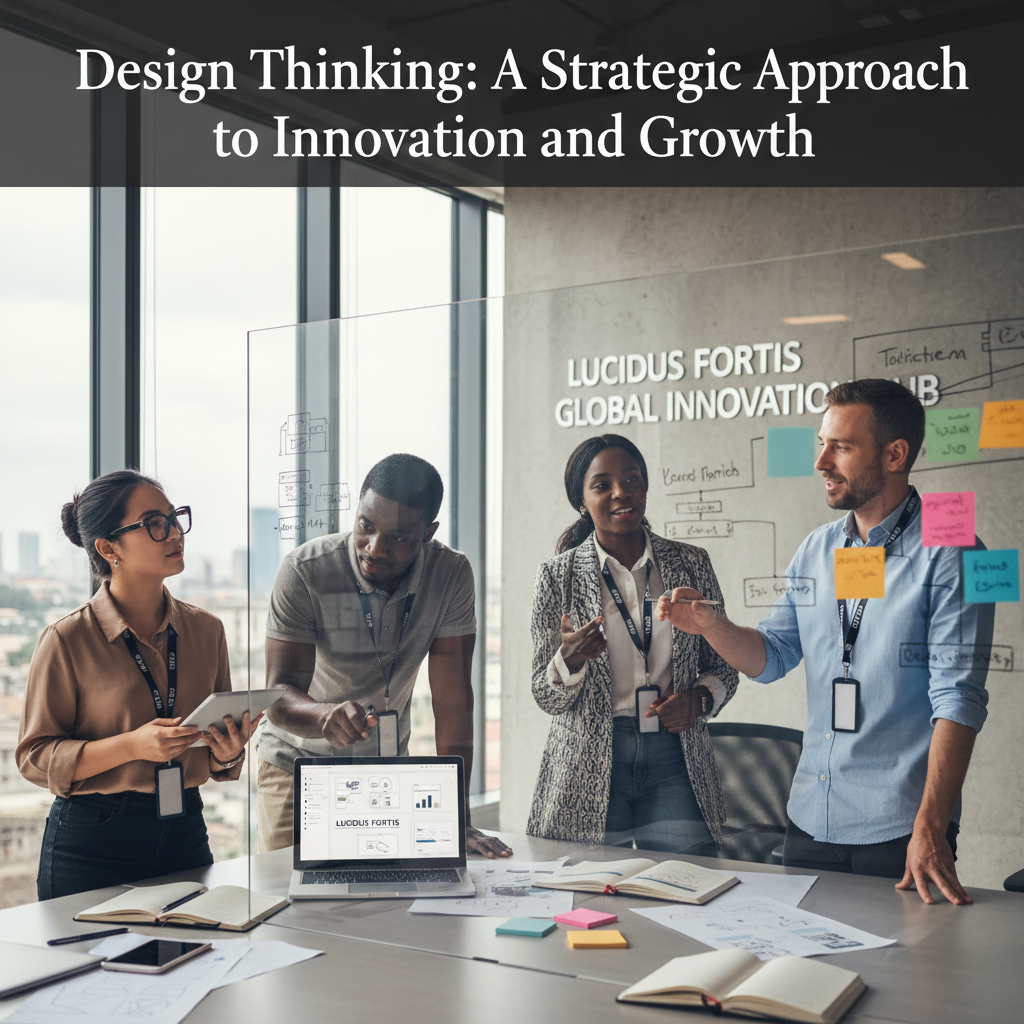
Design Thinking A Strategic Approach to Innovation and Growth
At Lucidus Fortis, we embrace Design Thinking as a powerful methodology to navigate complex challenges and foster innovation. By integrating this human-centered approach, we help organizations unlock new opportunities, enhance customer experiences, and drive measurable growth. This article explores how we apply Design Thinking to deliver exceptional results and elevate people satisfaction across diverse industries.
The Core Principles and Process of Design Thinking
While the previous chapter established the strategic imperative for a human-centric approach, the true engine of transformation is the rigorous, repeatable methodology that makes it actionable. Design Thinking is not a vague philosophy; it is a disciplined, iterative process rooted in a specific mindset and cognitive toolkit, essential for tackling the wicked problems that define modern markets. At Lucidus Fortis, we operationalize this as our core engine for innovation consulting services, moving beyond superficial brainstorming to drive measurable corporate performance improvement.
Historically emerging from a blend of engineering and the arts, Design Thinking’s power lies in its cognitive principles: solution-focused thinking that expands possibilities, and abductive reasoning—the logic of what could be—which allows us to envision viable futures amidst uncertainty. This enables the co-evolution of problem and solution, where initial problem statements are continuously refined as new solutions are prototyped, ensuring we solve the right problem, not just the obvious one.
Our five-phase, non-linear process embodies this:
- Empathize: We conduct deep, ethnographic user research to uncover latent needs, building a foundation of genuine insight.
- Define: We synthesize research to frame the core human-centric problem, creating a precise springboard for ideation.
- Ideate: In structured sessions, we leverage cross-functional teams to generate a breadth of radical ideas, deferring judgment to maximize creativity.
- Prototype: We build rapid, low-fidelity models—from storyboards to mock-ups—to make ideas tangible and testable quickly and cheaply.
- Test: We return to users, using prototypes to gather feedback, validate assumptions, and refine both the solution and our understanding of the problem.
Lucidus Fortis applies this to complex industry challenges. In fintech, we’ve used journey prototyping to redesign onboarding flows, boosting conversion by 30%. In healthcare, empathy work with patients and clinicians co-evolved into a new digital adherence platform. For a sustainable energy client, iterative prototyping of a customer portal simplified complex data, increasing engagement and supporting cross-border business growth. This process directly fuels operational excellence and revenue by de-risking innovation, while the collaborative nature boosts employee engagement, as teams see their ideas shape real-world outcomes. It is the essential human-centered scaffold upon which advanced, AI-driven business consulting is built.
Conclusions
Design Thinking is more than a methodology; it’s a mindset that fuels transformation. At Lucidus Fortis, we integrate it into every facet of our work, empowering clients to achieve sustainable success. By embracing empathy, creativity, and iteration, organizations can navigate change, foster growth, and enhance satisfaction. We invite you to partner with us and unlock your potential through strategic innovation.