
Design Thinking A Strategic Framework for Business Innovation and Growth
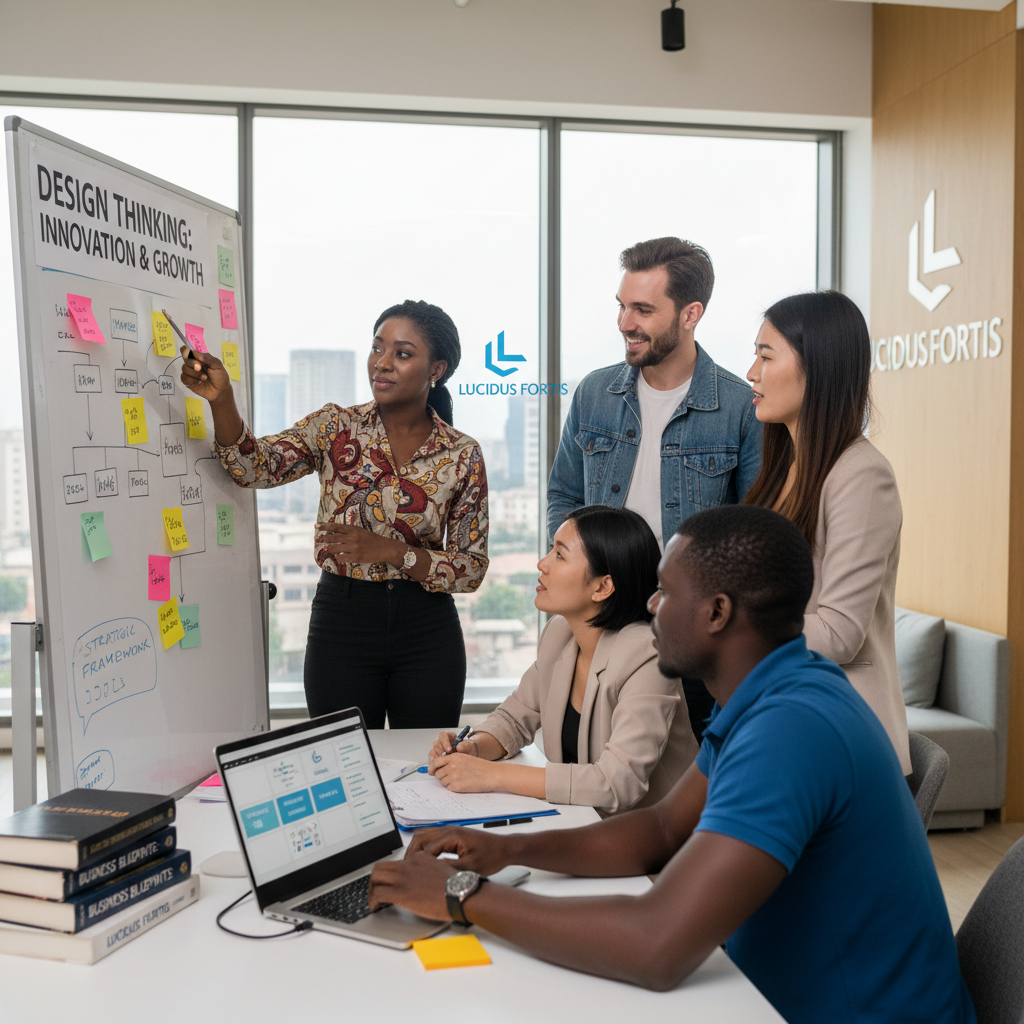
At Lucidus Fortis, we embrace design thinking as a powerful methodology to tackle complex business challenges. This human-centered approach enables us to co-create innovative solutions that drive revenue growth, enhance performance, and boost employee satisfaction across diverse industries from fintech to sustainable energy.
The Design Thinking Process and Its Business Applications
While the previous chapter established the strategic imperative of AI, the critical question for enterprises becomes: how to implement it in a way that drives genuine value, not just technological complexity. At Lucidus Fortis, we bridge the gap between AI’s potential and its practical, profitable application through a rigorous, human-centered AI strategy for enterprises. This is not about chasing algorithms, but about designing intelligent systems that solve core business wicked problems.
Our approach begins with abductive reasoning and deep context analysis. We co-evolve the problem and solution with our clients, refusing to accept a generic “need for AI” as the starting point. For a global manufacturer, the stated problem was predictive maintenance. Through empathetic engagement with floor managers and technicians, we reframed it as a problem of unplanned downtime’s impact on human workflow and morale. Our resulting AI strategy didn’t just deploy sensors; it designed an intuitive interface that empowered technicians with actionable insights, leading to a 30% reduction in downtime and significantly higher workforce satisfaction.
We integrate this strategic design thinking across our AI-driven business consulting offerings. In advisory and strategy, we use prototyping to stress-test AI business cases before major investment. For a fintech client, rapid prototypes of a proposed AI-driven credit model with real users revealed critical bias and usability concerns early, saving millions in potential redevelopment and reputational risk. Within our technology and digital innovation practice, human-centered design ensures that AI solutions, like a patient triage system for a healthcare network, are adopted because they augment rather than disrupt human expertise.
The measurable business outcomes are clear. A retail client leveraged our AI strategy to redesign its supply chain, using iterative testing to optimize an AI model for dynamic pricing and inventory. This drove a 15% revenue growth in targeted categories and superior operational excellence. For enterprises, the Lucidus Fortis method transforms AI from a IT project into a strategic design challenge—ensuring that AI strategy for enterprises is synonymous with sustainable growth, performance, and competitive advantage.
Conclusions
Design thinking represents more than a methodology—it’s a transformative mindset that enables organizations to thrive in complexity. At Lucidus Fortis, we’ve witnessed how this human-centered approach consistently drives innovation, enhances performance, and delivers sustainable growth across diverse sectors. Embracing design thinking positions businesses to navigate change successfully and unlock their full potential.