Ecosystem Mapping for Strategic Business Growth
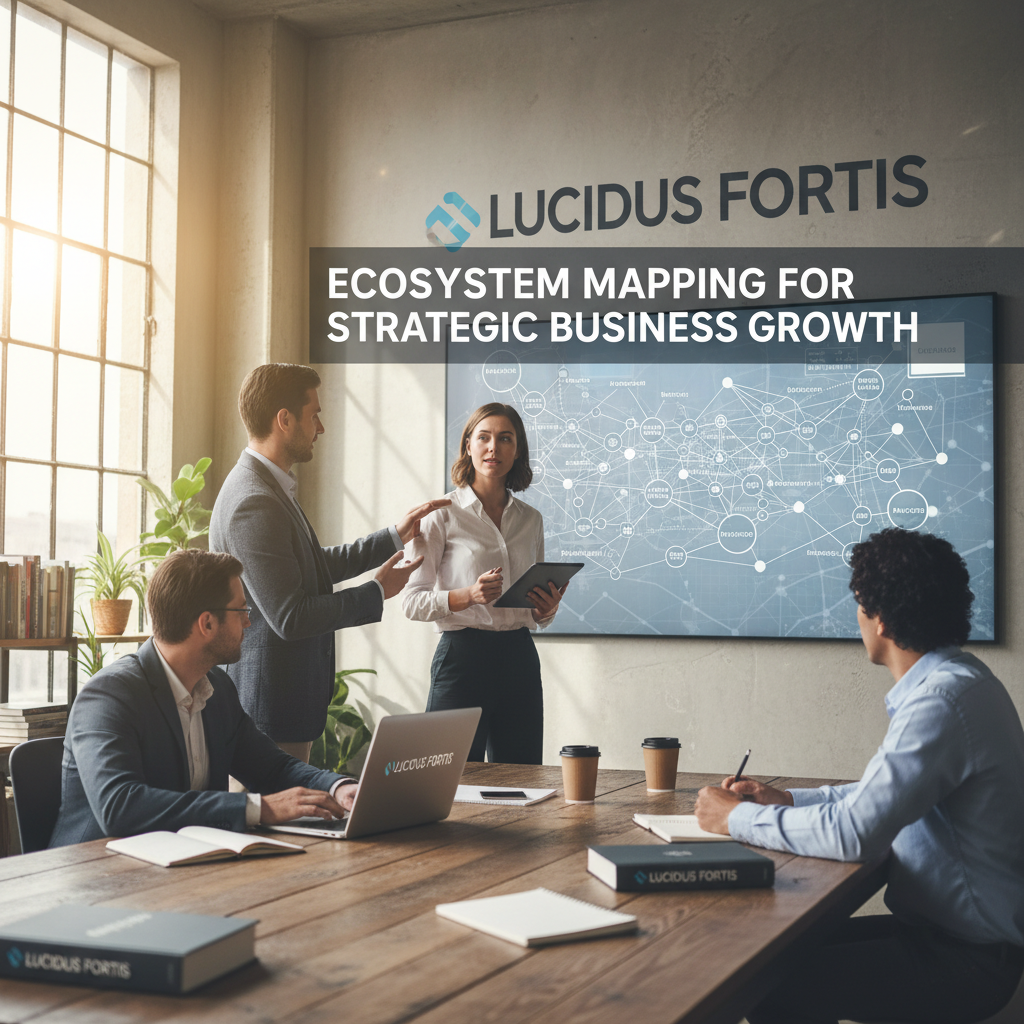
At Lucidus Fortis, we’ve discovered that ecosystem mapping is the cornerstone of navigating today’s complex business landscape. By visualizing the intricate networks of stakeholders, technologies, and market forces, we help organizations identify untapped opportunities and mitigate hidden risks. This strategic approach has become integral to our advisory services, enabling us to drive measurable growth and enhance operational performance across diverse industries.
The Strategic Framework of Business Ecosystem Mapping
The integration of AI strategy for enterprises is no longer a speculative venture but a core determinant of competitive resilience and growth. At Lucidus Fortis, we architect AI strategies that are not isolated technological deployments but are deeply embedded within a company’s broader business ecosystem. This ensures that AI initiatives are coherent, scalable, and directly tied to tangible value creation, moving beyond experimentation to drive sustained operational excellence and revenue.
Our approach begins with a critical diagnostic: aligning AI capabilities with strategic business outcomes. We assess an organization’s data maturity, technological infrastructure, and talent readiness against its market position and ecosystem dynamics. This prevents the common pitfall of technology-led solutions in search of a problem. Instead, we identify high-impact use cases—such as predictive supply chain optimization, hyper-personalized customer engagement, or automated regulatory compliance—that are validated by our ecosystem mapping to ensure they address genuine market friction points and leverage existing partner networks.
We then design and implement a phased roadmap for AI adoption, emphasizing ethical governance, change management, and continuous learning. A cornerstone of our Lucidus Fortis AI consulting methodology is the creation of a “human-in-the-loop” framework, where AI augments decision-making and automates routine tasks, thereby elevating the strategic role of our clients’ teams. This directly enhances people satisfaction by removing mundane workloads and empowering employees with advanced analytical tools. We integrate business process optimization with AI deployment, ensuring that new intelligence flows seamlessly into core operations to improve performance metrics like time-to-market, cost efficiency, and customer lifetime value.
For a global manufacturer, we deployed an AI-driven ecosystem intelligence platform that continuously analyzes supplier networks, geopolitical factors, and logistics data. This transformed their supply chain from a cost center into a strategic, predictive asset, mitigating risks and unlocking new efficiencies. In cross-border business growth scenarios, our AI strategies help clients navigate regulatory landscapes and identify partnership opportunities with unparalleled precision. By treating AI as an integral thread in the ecosystem fabric, we enable enterprises to not just adopt technology, but to evolve into truly technology-driven and adaptive organizations, securing their leadership in an era of perpetual innovation.
Conclusions
Ecosystem mapping has proven to be more than just a strategic tool—it’s a transformative discipline that reveals hidden connections and opportunities. At Lucidus Fortis, we’ve seen firsthand how this approach drives sustainable growth, enhances competitive advantage, and fosters innovation. By embracing ecosystem thinking, organizations can navigate complexity with confidence and achieve lasting success in an ever-evolving business environment.