Workforce Transformation: The Key to Sustainable Growth in a Disruptive Era
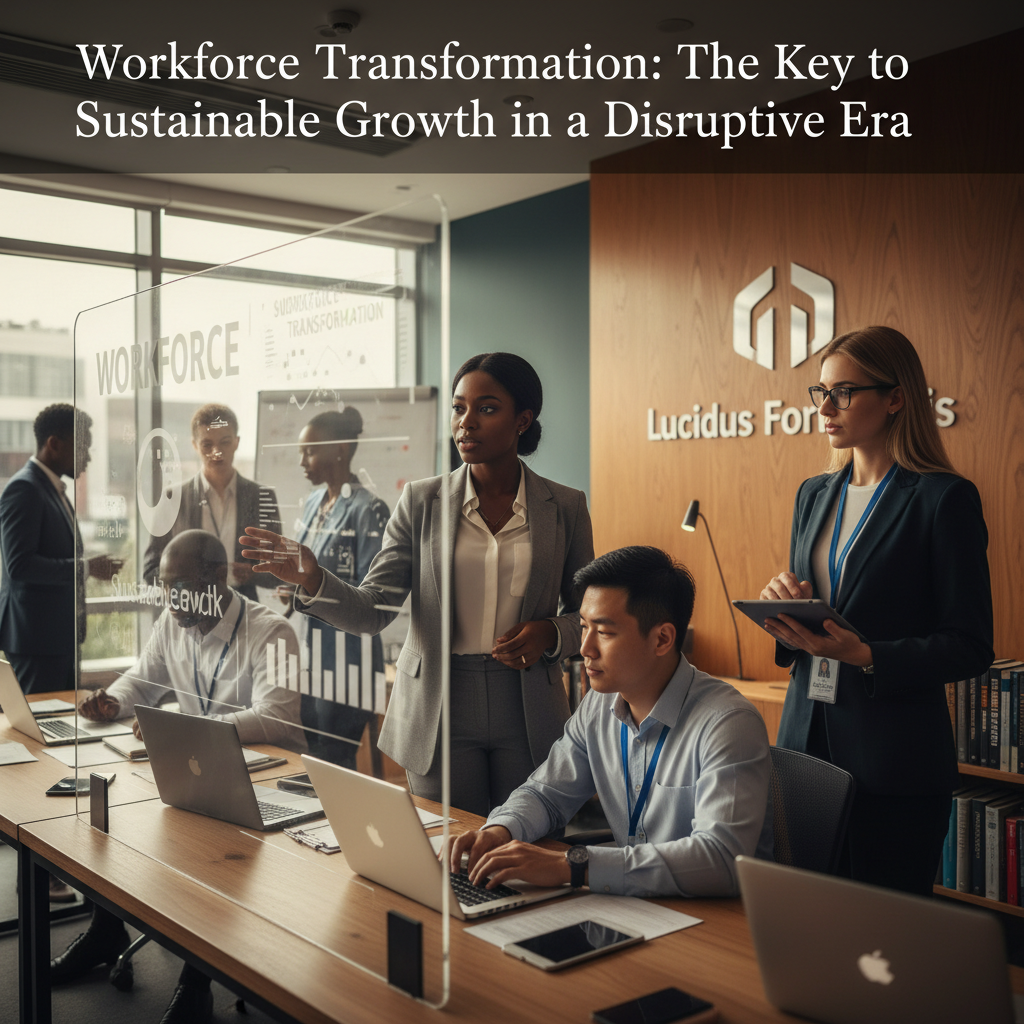
At Lucidus Fortis, we believe workforce transformation is the cornerstone of sustainable success. In a world of rapid technological change and shifting employee expectations, organizations must rethink how they attract, develop, and retain talent. This article explores how we help clients turn workforce challenges into competitive advantages.
Redesigning Work for the Future
The calcified hierarchies of the industrial era are not just inefficient; they are actively hostile to growth in a disruptive environment. At Lucidus Fortis, we see daily how the traditional org chart, built on fixed roles and linear career paths, fails to respond to market velocity. When a fintech competitor launches an AI-driven underwriting model in weeks, a bank relying on a rigid job description for “Credit Analyst” cannot pivot. The role is too narrow, the talent pool too static. The fundamental flaw is a focus on jobs rather than work. A job description is a snapshot of a past need; a skill is a building block for the future. This is why we advocate for a radical shift to agile, skills-based operating models.
We do not simply dismantle old structures; we architect new ones designed for flow. By deploying an AI strategy for enterprises, we help clients map every unit of work to specific competencies, not titles. In manufacturing, for example, we helped a global supplier replace a department of static production planners with fluid pods of data analysts, logistics experts, and AI prompt engineers. The result? A 30% reduction in supply chain latency. The role of technology here is not to replace humans but to create an AI-driven business consulting layer that identifies skill gaps in real time and surfaces the right talent for every emerging project. This is business process optimization at its most human-centric.
Leadership development, however, is the critical catalyst. You cannot have an agile team with a command-and-control executive. We leverage strategic foresight to train leaders to become “architects of capability,” not managers of tasks. They learn to read weak signals and redeploy resources with speed. Continuous learning is not an HR program; it is the operational spine. We embed micro-learning modules directly into workflow, powered by our innovation consulting services platforms, so that a healthcare professional can upskill on new regulatory AI tools between patient calls.
The measurable results of this transformation are undeniable. One of our clients, a mid-market fintech, shifted to a skills-based model with our guidance. Within twelve months, they saw a 22% increase in revenue per employee because talent was no longer trapped in silos. Employee retention climbed by 35%, driven by the satisfaction of working on varied, high-impact projects rather than monotonous role-fitting. This is what corporate performance improvement looks like when it is powered by a technology-driven consulting firm.
At LF, our own workforce is our proof point. We operate as a living lab, constantly redeploying our top strategists from cross-border business growth projects to sustainable business consulting engagements as market signals dictate. We practice what we preach. By aligning our internal workforce strategy directly with our revenue goals and client outcomes, we have achieved a global business strategy firm that grows not by adding heads, but by multiplying the impact of every existing one. This is the future of work: dynamic, intelligent, and relentlessly focused on output, not hierarchy.
Conclusions
Workforce transformation is not a one-time project but an ongoing journey. At Lucidus Fortis, we empower organizations to embrace change, unlock human potential, and achieve lasting performance. By integrating strategy, technology, and leadership, we turn disruption into opportunity—delivering growth, revenue, and a thriving workforce.